

Uniquely 5: Japan’s Finest
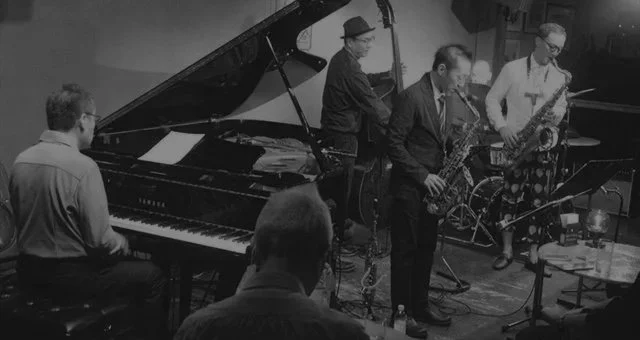
Uniquely 5 is an aptly named quintet consisting of some of the baddest musicians not just in Japan, but in the world. Clark Terry used to say the art of improvisation could be mastered in three steps: Imitation, Assimilation, and Innovation. It’s clear when listening to Uniquely 5 that each man has reached the pinnacle of his craft, beyond imitation and assimilation. More than echoes of giants long passed. This is hard bop that swings with the conviction of the early 60s Blue Note sessions, played by musicians who understand that tradition is more than preservation—it’s about carrying the flame.
Of the musicians keeping the flame lit, it is only right to first address the bed of hot coals, the foundation: the rhythm section. On bass is Yosuke Inoue. Born in Osaka in 1964, he began his professional career while studying at Osaka College of Music, and after moving to Tokyo, he joined various groups such as Motohiko Hino Band and Masahiko Sato Band. In 1991, he moved to New York, where he performed with jazz legends such as Roy Hargrove and the great Hank Jones. That’s serious company, and it shows. Like a bed of coals, Inoue is calm, steady, and cookin’.
On the drums (and cymbals), Yoshihito Eto drives the band with strength and subtlety; like oxygen to fire, he is the source of its life. Born in 1973, Eto went pro with Fumio Karashima’s trio in 1996, and his talent propelled him to join Sadao Watanabe’s band in 1998, performing in numerous concerts including the Montreux Jazz Festival. What makes Eto exceptional is his incredible ability to hear and react—he propels the band forward but, more importantly, he always listens, always responds. His pocket feel with Inoue on bass is magical. He has released seven albums as a leader, and his “Eto Matsuri” live sessions featuring new talent have earned acclaim throughout the Land of the Rising Sun.
Completing the rhythm section is the distinguished pianist Yutaka Shiina, whose colorful voicings serve as the smoke to the fire. Dancing above the flames, ascending to the skies, drawn to and fro by the wind. Born in 1964, Shiina studied composition at the Kunitachi College of Music and, in 1989, earned a place in Lionel Hampton and Vincent Herring’s bands for their Japan tours. The following year, he became part of Roy Hargrove’s quartet. He was a founding member of the Jazz Networks, leading the band from 1992, and his early recordings as a leader featured rising stars like Reginald Veal, Herlin Riley, Nicholas Payton, Christian McBride, and Greg Hutchinson. But it was his work with the late great Elvin Jones, who hired Shiina and invited him around the world on multiple tours in the mid-90s, that cemented his reputation. As a player, his comping is subtle, intelligent,
and unobtrusive—he knows when to lay back and when to interject. A brilliant composer, the first tune of the set is an original from Shiina entitled “Bluetooth”.
Last, but certainly not least, the horns. The fuel to the fire: the firewood, the gas. Without the melodic and monophonic forces of the horn section, the fire lacks fuel. Up front on alto saxophone, the incredible Kazuhiko Kondo channels the spirit of the great alto men—Sonny Stitt’s fluidity in phrasing at up tempos, Jackie McLean’s bluesy edginess and cryin’ tone. His sound is bright, and his lines are guided by the rhythmic impulsivity and technical braggadocio of hard-bop. Also born in 1964, Kondo has had a prolific career as a studio musician, with credits ranging from Dragon Ball Z to Super Mario. His arrangement of Pittsburgh native Horace Silver’s tune “Barbara” has a beautiful harmonization of the melody shared by the saxes, and suits the band uniquely well.
On tenor saxophone, the unmistakable Wataru Hamasaki. Hamasaki was born in Nagasaki, and in 1996, went to the Nagoya City University School of Medicine to become a medical doctor. After graduating, he won first place in the Selmer Saxophone Competition in Japan, which earned him great recognition in the local jazz scene. As a leader, he has released nine albums. He has a voice that echoes the great tenor men of the bebop and hard-bop era, much like Frank Foster—that big, warm tone combined with harmonic sophistication and clever phrasing creates a timeless sound.
Together, Uniquely 5 is an absolute powerhouse of jazz. Their sound rivals that of some of the best recordings from the 60s: pure hard-bop, in all its glory. Serving as a shining representation of (and for some, an introduction to) the excellence of the Japanese jazz scene. Truly, a sight and sound to behold.
by Theo Bookey