

Albums and Artists to Start Listening to Jazz
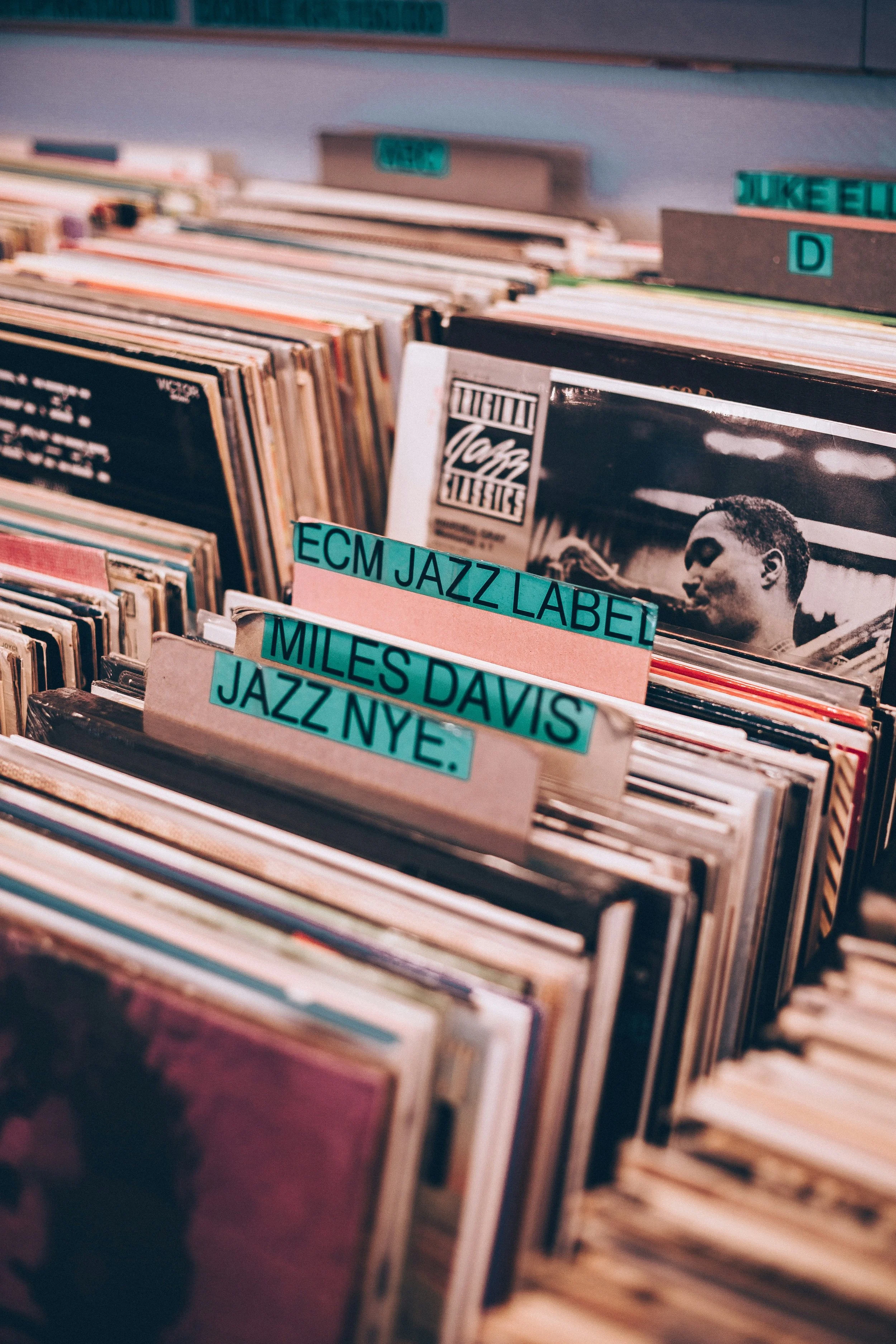
Jazz is a musical genre that has traveled around the world. It is celebrated for its standards, its instruments, and its distinctive sound that has evolved over time. Entering this world—which for many feels confusing and difficult to listen to—can be an arduous and intimidating task. That is why here we will talk about the essential jazz artists and albums: works that captivated audiences, that will live on forever, and that every jazz lover should know.
1.
To begin this list, we must introduce Time Out by Dave Brubeck and his quartet. Released in 1959, it includes the classic “Take Five,” a blend of the familiar with unexpected shifts that surprise the listener. This album is a landmark because it represents the essence of swing and became a symbol of the jazz sound of its era. It is perfect for beginners, featuring fluid swing, catchy melodies, and bringing together four masters: Dave Brubeck, Paul Desmond, Eugene Wright, and Joe Morello.
2.
Also in 1959, an unmatched and almost inexplicable gem was released. Miles Davis surprised the world with Kind of Blue, an album developed in the modal jazz world. It uses fewer chords and revolves around fixed scales, serving as an exploration of a musical territory that was not perceived as the most commercial—yet it became a global success, the best-selling jazz album and one of the greatest in history. Davis assembled an all-star lineup full of talent: John Coltrane (whom we will mention later), Cannonball Adderley, Bill Evans, Paul Chambers, Wynton Kelly, and Jimmy Cobb. There were ideas and sketches of what was sought, but in practice, the musicians improvised and let themselves go. With such a talented and unique group, there was no way the results would not be successful. What emerged, however, touches perfection. “So What,” “Freddie Freeloader,” “Blue in Green,” “All Blues,” and “Flamenco Sketches” make up this creation. Listening to them in order is a journey that begins with the relaxed rhythm and atmosphere of “So What” and ends with the Spanish-tinged elements of “Flamenco Sketches.”
3.
Heroic figures who delighted us in the previously mentioned release also forged their own solo paths. John Coltrane was a superstar who experimented and brought profound changes to his life—struggling intensely with addiction before finding a spiritual path that redefined him. In 1957, he released Blue Train, where a young Coltrane can be heard captivating audiences alongside an exceptional lineup: Lee Morgan, Curtis Fuller, Kenny Drew, Paul Chambers, and Philly Joe Jones. It has a dark atmosphere that unfolds through its arrangements, catchy melodies, and the musicians’ perfect execution.
Following the path this master traveled in his life, one can move from Giant Steps to A Love Supreme, an expression that reflects his spiritual process and transformation through modality and a concept that serves as a portrait of his inner evolution.
4.
Moving into other essential territory, we must talk about Moanin’ by Art Blakey and the Jazz Messengers, a group led by the drummer. This 1959 album is full of successes such as “Are You Real,” “Along Came Betty,” “Blues March,” “Come Rain or Come Shine,” “The Drum Thunder Suite,” and the title track. It appeals to the roots of jazz—blues and the church. The pieces included here are standards performed worldwide in thousands of versions.
5.
Charlie Parker is a legend who, in his short life, left an indelible mark on music. Anyone interested in enjoying bebop and the essence of jazz should turn to Best of the Complete Savoy & Dial Studio Recordings, which gathers works such as “Moose the Mooche,” “Yardbird Suite,” “Ornithology,” and “A Night in Tunisia.” Miles Davis also participates in these recordings, and together they bring to life some of the most recognized jazz standards.
6.
One cannot speak of jazz without mentioning Ella. That is why this list includes Ella Fitzgerald Sings the Cole Porter Songbook (1956), where she had the opportunity to record her voice with superior sound quality compared to her earlier work. Songs like “Night and Day,” “I Love Paris,” and “Anything Goes” are the indispensable gems of this production.
7.
Now comes one of the most important musicians in American history: Louis Armstrong. A vocalist and trumpeter whose unique voice captivated audiences and placed him in the Olympus of jazz. The Complete Hot Five and Hot Seven Recordings (1925–1929) compiles standout works such as “Potato Head Blues,” “Heebie Jeebies,” and “Struttin’ With Some Barbecue.” Later, he would release other unforgettable productions like “What a Wonderful World” and “La Vie en Rose,” both essential for any music lover.
And if Louis Armstrong and Ella Fitzgerald stole your heart (which is very likely), listen to the album Ella and Louis, where they come together to create something spectacular.
8.
The Essential Duke Ellington is the definitive gateway to understanding the magnitude of one of the genre’s most prolific composers. This compilation synthesizes decades of genius, showing how Ellington transformed his orchestra into a single instrument to paint soundscapes ranging from the urban sophistication of “Take the ‘A’ Train” to the deep melancholy of “Mood Indigo.” It is an essential journey for beginners, demonstrating that jazz is not only individual improvisation but also an elegant and ambitious architecture that elevated popular music to the level of American classical art.
9.
Jazz also fused and traveled to Brazil. The album Getz/Gilberto (1964) by Stan Getz and João Gilberto could not be left out of this selection. First, because it includes the incomparable “The Girl from Ipanema,” and second, because it represented the union of two worlds and two cultures that became a Brazilian symbol and traveled the globe.
Astrud Gilberto’s career began through a fortunate accident in 1963 during the recording of Getz/Gilberto. While Stan Getz and João Gilberto were recording “The Girl from Ipanema,” a need arose for an English-language voice. Astrud, who was accompanying her husband in the studio, took on the challenge despite not being a professional singer. Although she was not initially credited, the edited version featuring her voice became a worldwide success, solidifying this album as an essential pillar of jazz and bossa nova.
From this selection, one can say there is abundant material to begin wandering through the landscapes of jazz. We must also mention Billie Holiday, Nat King Cole, and Thelonious Monk. After finishing the previously presented selection, listeners can continue exploring the music of these masters.
Many paths have been created over time. This list attempts to cover different styles and eras of jazz. Ultimately, each listener decides which style they prefer and which musician moves their heart most deeply. What is certain is that here there is an abundance of talent, quality, and magic in the art of making jazz music.
by José Mejía